
Every app roundup ranks features. Rank these six as a monthly dividend income planner app instead, and a different question decides the order: how well does the app handle the pay calendar? Because the calendar is lumpy. In our database of 197 dividend stocks, 181 pay quarterly, 12 pay monthly, 2 pay semi-annually and 2 pay annually. A planner that quietly assumes smooth monthly income is planning a fiction, and the right Android app is the one that shows you the lumpiness instead of hiding it.
The six apps, with their claims intact
- Stock Events: ex-dividend calendar with push alerts, freemium.
- Snowball Analytics: portfolio income projections.
- Yahoo Finance: free all-rounder with dividend data.
- Seeking Alpha: dividend news and grades.
- TrackYourDividends: clean income dashboard.
- My Stocks Portfolio: widgets for daily income tracking.
The killer feature on Android is still the widget: your forward annual income on the home screen, updating with every buy. Watching projected income climb is the most motivating number in investing. But a yearly total on a widget is a tracking number, not a plan. The plan lives in the month view, and the month view is only honest if the app knows how rarely monthly payers actually occur.
The calendar problem, counted
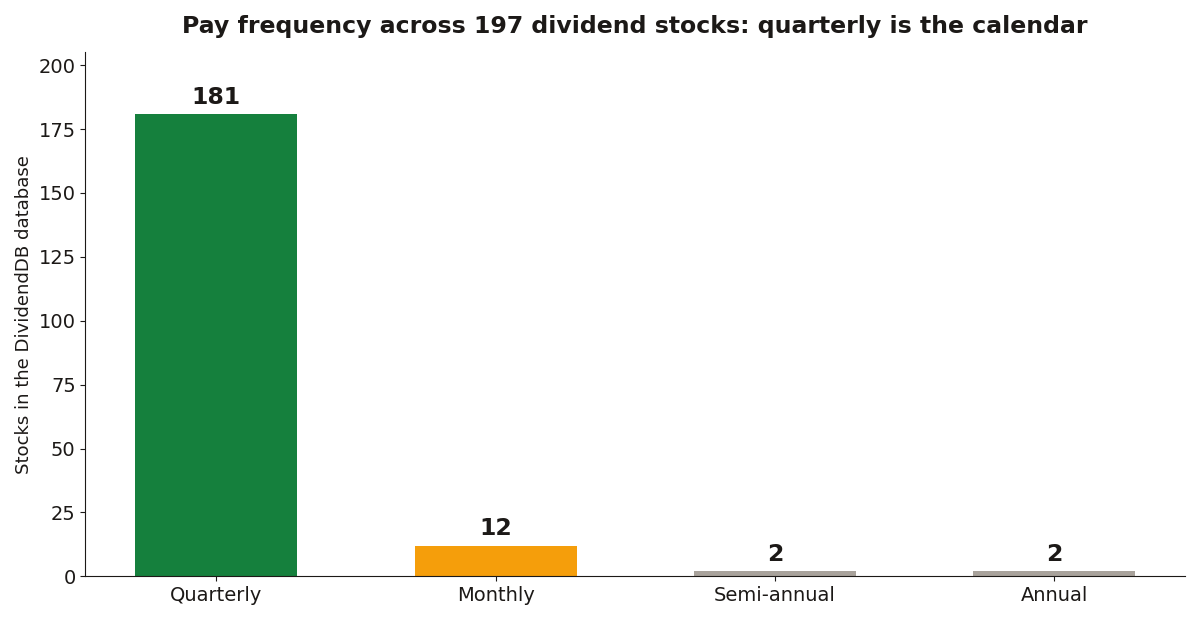
Quarterly is the calendar. About 92 percent of the database pays four times a year, which means a monthly income plan is really a staggering exercise: three groups of quarterly payers, offset so one group lands each month. The 12 true monthly payers are Realty Income, Agree Realty, EPR Properties, Main Street Capital, LTC Properties, SL Green, Gladstone Commercial, Gladstone Land, Gladstone Capital, Gladstone Investment, AGNC Investment and PennantPark Floating Rate Capital. Eight of the 12 sit in real estate and the other four in financial services, so a plan built only on monthly payers is also a concentrated bet on two sectors.
The monthly 12 do pay more for the trouble: their median yield is about 6.0 percent, against a median of 3.4 percent across all 196 stocks with a recorded yield. That gap is the market pricing the concentration and the shorter track records. A good planner app makes both numbers visible, the income and the concentration, before you buy rather than after.
There is a second calendar fact the planner has to respect: quarterly payers do not all pay in the same months. A stock paying in January, April, July and October fills a different slot than one paying in February, May, August and November, and the database records an ex-dividend date and a pay date for every stock, so the slots are checkable rather than guessable. Twelve monthly payers would be the lazy solution. Three offset groups of quarterly payers are the diversified one, and the app you pick has to show both views, the per-stock calendar and the per-month total.
Which app plans, and which app tracks
For the calendar itself, Stock Events remains the one to beat on Android: the ex-dividend calendar with push alerts is exactly the feature a staggering plan runs on. Snowball Analytics earns its place when you want forward income projections month by month, which is the planner view rather than the tracker view. Yahoo Finance is the free all-rounder when you just need dividend data next to everything else, and Seeking Alpha is the pick for dividend news and grades around the positions you already hold.
TrackYourDividends keeps the cleanest income dashboard of the six, and My Stocks Portfolio is the widget specialist for daily income tracking. The honest split: two of these apps plan (calendar and projections), four of them track. Most investors end up with one of each, and that is fine, as long as the planning one is chosen on the calendar test above and not on the prettiest chart.
Build the plan first, then track it
The workflow that works: set the monthly target first, then let the trackers report against it. Our Dividend Income Builder takes a target monthly income and your capital and builds a sample portfolio out of the same database this article counts, frequency mix included. Run the target through the builder, look at which months the sample portfolio actually pays in, and only then load the tickers into Stock Events or Snowball and let the alerts do the babysitting.
One last planner habit worth stealing from the tracker apps: review the calendar monthly, not daily. Confirm next month's expected payouts, check for announced cuts, and leave the staggering alone the rest of the time. Dividend income rewards the investor who plans once and then mostly watches.
Sources: Nasdaq, Morningstar